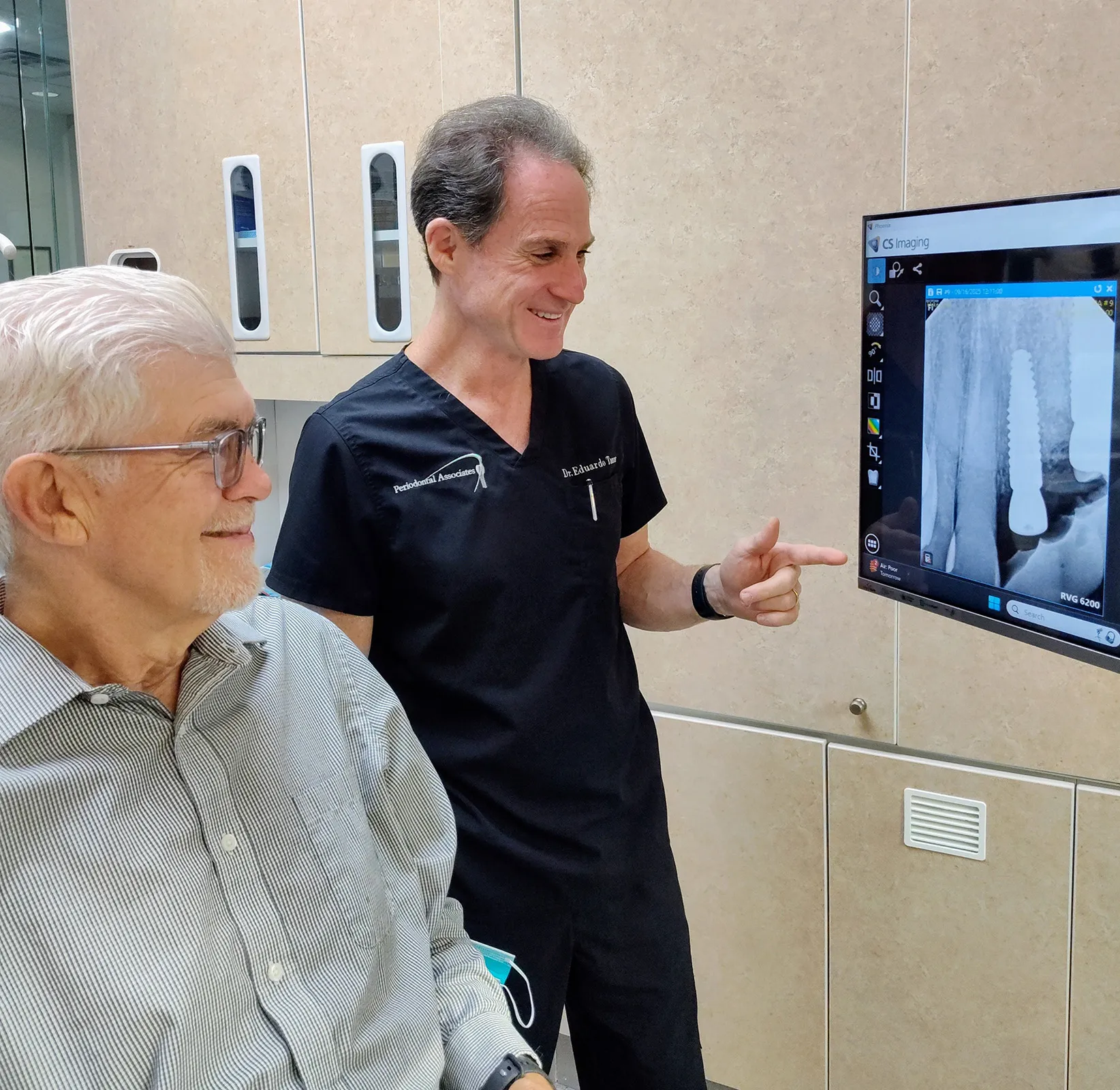
Comprehensive oral examination

Scaling and Root Planing in Dallas
What Is Scaling and Root Planing?
Scaling and root planing is the deep cleaning used to treat periodontitis, the stage of gum disease where infection has moved below the gumline and started to separate the gums from the teeth. At Dallas Periodontal Associates, it is usually the first step in our gum disease treatment in Dallas, and in some cases a thorough deep cleaning is enough to bring the infection under control.
The treatment has two parts. Scaling removes the plaque and hardened calculus (tartar) that have collected on the teeth above and below the gumline. Root planing then smooths the root surfaces, which makes it harder for bacteria to attach and gives the gums a clean surface to heal against. Dr. Eduardo Tanur and Dr. Ruben Ovadia are both periodontists and Diplomates of the American Board of Periodontology, and our hygienists are trained to the standards of a periodontal practice.

How Do You Know If You Need a Deep Cleaning?
Gum disease is often quiet. It usually progresses without pain or discomfort until it is severe, so it is worth knowing the signs. Signs that it is time for a periodontal exam include:
- Gums that bleed when you brush or floss
- Red, swollen or tender gums
- Bad breath that does not go away
- Gums that have pulled away from the teeth, or teeth that look longer than before
- Teeth that have shifted or feel loose
- Pus between your gums and teeth, or pain when chewing
Bleeding gums are not normal. They are a sign of inflammation and infection. As the gums detach, a pocket forms between the gum and the tooth. Bacteria collect in that pocket and harden into calculus, which irritates the gums further and keeps the infection going. A deep cleaning is designed to clear those pockets.
To confirm the diagnosis, Dr. Tanur or Dr. Ovadia performs a comprehensive exam, takes digital X-rays and uses our cone beam scanner for 3D images of your jaw structure, teeth and gums. They also review your medical and dental history, because conditions such as diabetes can make gum disease harder to control.
How Is Scaling and Root Planing Different From a Regular Cleaning?
A routine cleaning and a deep cleaning are built for different situations. The table below shows how they compare, along with the periodontal maintenance visits that follow treatment.
| Routine cleaning | Scaling and root planing | Periodontal maintenance | |
|---|---|---|---|
| Who it is for | Healthy gums | Active periodontitis with pockets below the gumline | Patients who have completed gum disease treatment |
| Where it cleans | Mainly at and above the gumline | Above and below the gumline, down to the root surfaces | Above and below the gumline to keep pockets clean |
| Root smoothing | No | Yes, roots are planed smooth | As needed |
| How often | Set by your dentist | As active treatment, per your treatment plan | At an interval the doctor tailors for you |
Once periodontitis has formed pockets, the plaque and calculus below the gumline need to be removed and the roots smoothed, which is what scaling and root planing does.
What Happens During Scaling and Root Planing at Our Dallas Office?
Treatment starts with a conversation. The doctors explain what gum disease is, how far yours has progressed and what they plan to do, so you understand each step before it begins.
Scaling. We use Piezo ultrasonic scalers together with hand instruments. The ultrasonic scaler sends out high-frequency vibrations that loosen plaque and calculus from the tooth and below the gumline, and the scalers can be adjusted for your comfort.
Root planing. Once the deposits are removed, the root surfaces are smoothed. A smooth root is harder for bacteria to cling to and easier for the gums to reattach to.
Extra help for stubborn pockets. For more severe infection, the doctors may use laser therapy to remove damaged gum tissue and eliminate bacteria from deep pockets.
If dental visits make you anxious, ask about sedation dentistry. We offer a sedative pill with nitrous oxide, and IV sedation given by a board-certified anesthesiologist.
Does Scaling and Root Planing Hurt, and What Is Recovery Like?
Comfort is built into every step. When a local anesthetic is needed, the doctors first apply a topical anesthetic to take away the “pinch” of the injection, and the ultrasonic scalers can be adjusted for your comfort. If you feel anxious about dental visits, sedation is available.
You will leave with home care instructions. Keep brushing and flossing gently, use the products your hygienist recommends, and keep your follow-up visit. The doctor assesses your healing about four weeks after your deep cleaning and decides whether further treatment is needed.
What If a Deep Cleaning Is Not Enough?
In some cases a thorough deep cleaning is all it takes to bring gum disease under control. When pockets are too deep for cleaning to reach, the doctors may recommend treatment for advanced periodontitis. A small incision in the gums gives access to the deposits on the roots, which are removed before the roots are smoothed.
Gum disease can also leave lasting damage. Any loss of bone, gum or connective tissue is permanent, but it can be restored through grafting. Gum grafting covers exposed roots and rebuilds a healthier gumline, and bone grafting can replace bone lost to periodontitis.
How Do You Keep Gum Disease From Coming Back?
Gum disease is persistent, and it can return easily if follow-up care is not adequate. That is why scaling and root planing is followed by periodontal maintenance. The doctor tailors how often you come in to your needs and gives our hygienists any special instructions for your care.
Our hygienists have over 25 years of experience. They also teach home care, showing you how to brush and floss effectively and recommending the tools that suit your mouth. Controlling risk factors matters too: smoking, diabetes and stress all make gum disease harder to keep in check.
Why See a Periodontist in Dallas for Scaling and Root Planing?
Periodontists are dental specialists in the gums and the bone that supports the teeth, with three additional years of training after dental school. Dr. Tanur became a certified periodontist in 1992 and opened the practice in 2001. Dr. Ovadia earned his periodontal certification in 2010 and joined him to form Dallas Periodontal Associates. Both are Diplomates of the American Board of Periodontology, a status earned by about 10% of periodontists.
Treatment with a specialist means the same doctors who diagnose your gum disease can also provide the next step if you need it, from laser therapy to grafting.
What Does Scaling and Root Planing Cost?
Cost depends on how many areas of your mouth need treatment and whether you need additional therapy, so the doctor gives you a written treatment plan after your exam. That plan comes out of your first visit, our $89 new patient exam.
We are not in network with dental insurance plans, but we will help you prepare and file your claim so you receive the maximum reimbursement your policy allows. We also offer a 5% discount when you prepay, and financing through CareCredit, Sunbit, Cherry and LendingClub. See our payment options for details.
Scaling and Root Planing FAQs
Yes. Deep cleaning is the common name for scaling and root planing. It treats periodontitis by cleaning below the gumline and smoothing the root surfaces.
All gum disease can be brought under control and the infection eliminated, and many cases are treated with deep cleaning alone. Any bone or gum that was already lost is permanent, but it can be restored through bone and gum grafting. Lasting control also depends on maintenance visits and on managing risk factors such as smoking.
It depends on how many teeth are involved and how deep the pockets are. The written treatment plan you receive after your exam will spell out what your treatment involves and how many visits to expect.
The doctor assesses your healing after your deep cleaning and decides whether further treatment is needed. From there, periodontal maintenance visits keep your gums healthy, because gum disease is persistent and can return easily if follow-up care is not adequate.
If your gums bleed, look swollen or have started to pull away from your teeth, schedule an exam with our Dallas periodontists at 8722 Greenville Ave #100, or call (214) 503-1000. Request an appointment and we will find out whether scaling and root planing is the right first step for you.
$89
NEW PATIENT EXAM
A $249 Value!